Corporate Wellness Blueprint: Blue Mind Science for Burnout Recovery
Discover how Blue Mind science reduces burnout, restores cognitive performance, and transforms corporate wellness. A strategic guide for HR leaders seeking neuroscience‑backed solutions.
BURNOUT RECOVERY TRAVEL
Leeanna Robbibs
6/19/20266 min read
🌅The Strategic Imperative: Transitioning from 'Red Mind' Stress to 'Blue Mind' Recovery
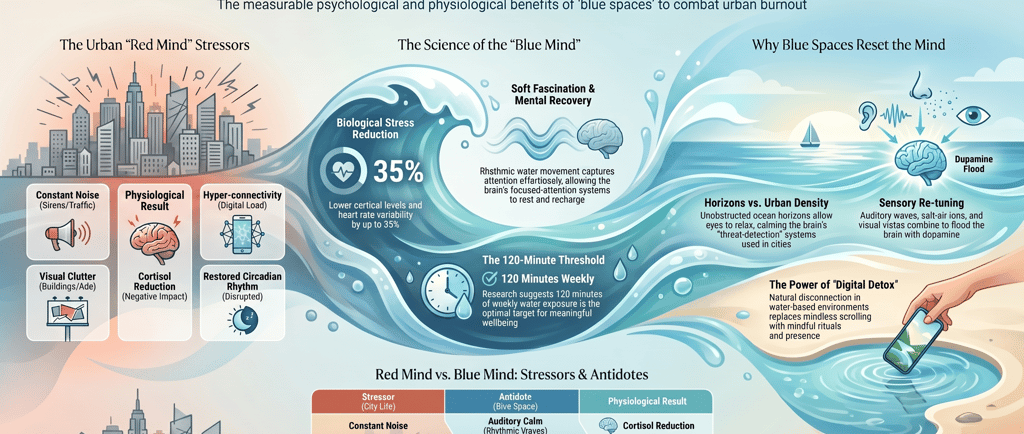
In the high-stakes corporate arena, the persistent erosion of human capital value is no longer a peripheral concern; it is a strategic crisis. Employees currently operate in a chronic "Red Mind" state—a neuro-physiological condition fueled by the "always-on" digital culture, economic stressors, and the lingering uncertainty of a post-pandemic global landscape. When left unmanaged, this stress matures into "Gray Mind" burnout, characterized by a total collapse of cognitive resilience and emotional engagement. For HR leaders, the pivot to "Blue Mind" interventions represents a critical investment in neurological recovery. By transitioning the workforce from a state of high-alert to a mildly meditative aquatic-based calm, organizations can trigger a biological "reset button" essential for maintaining a competitive, high-performing culture.
The Strategic Cost: Ignoring the Warning Signs
Failure to address the "Red Mind" state results in a systematic decline in well-being. Executive leadership must recognize these primary eroders:
Cognitive Fog & Executive Dysfunction: Significant reductions in problem-solving speed and memory retention.
Emotional Exhaustion: Persistent drainage that renders standard weekends or PTO insufficient for recovery.
Physiological Breakdown: Documented increases in high blood pressure and a severely weakened immune system.
Social Withdrawal: The loss of team cohesion as employees detach to conserve dwindling mental energy.
The transition from this debilitating stress to restorative health requires a deep dive into the biological mechanisms that make water a clinical necessity for neurological reset.
The Neurobiology of Restoration: Science-Backed Mechanisms of Blue Health
To justify wellness investments to the C-suite, one must view blue space not as an aesthetic luxury, but as a biochemical intervention. Understanding the physiological pathways activated by water provides the data-driven foundation for a robust human capital strategy.
The Biochemical and Electrical Reset
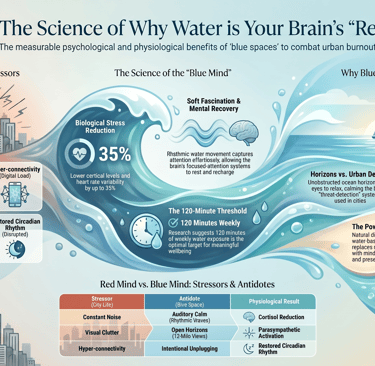
Exposure to aquatic environments triggers an immediate shift in brain chemistry. Research indicates that rhythmic ocean sounds alone can facilitate a 20% reduction in cortisol, while broader blue space exposure can drive that decrease up to 35%. Furthermore, aquatic soundscapes increase alpha wave activity in the brain, a neurological marker associated with relaxed alertness and creative flow. This is bolstered by high concentrations of negative ions found near moving water, which optimize serotonin levels and increase oxygen flow to the brain.
Attention Restoration Theory (ART) and "Soft Fascination"
Corporate performance is limited by "directed attention"—a finite resource exhausted by multitasking and screens. Water provides "Soft Fascination," a state where the brain is gently engaged by the predictable but dynamic movement of waves or reflections. This allows the brain's focused attention systems to rest, resulting in measurable improvements in accuracy and reaction times upon return to work.
The Biophilia Hypothesis: An Evolutionary Command
Our nervous systems are evolutionarily primed for aquatic relaxation. To our ancestors, water was the ultimate signal of fertile land and abundance. This innate affinity—Biophilia—means our brains process the sight and sound of water as a cue that we are in a "safe harbor," effectively downshifting the threat-detection systems of the brain.
The Seven-Form 'Bluescription' Framework: A Multi-Modal Access Strategy
A sophisticated wellness strategy must prioritize accessibility and equity. The "Blue Mind" state does not require a coastal headquarters; it requires a structured "Bluescription" of at least 23 minutes a day across various modalities.
1: Wild Blue Mind (Natural Waters): Oceans, lakes, or rivers.
Corporate Application: Designate "Blue Days" for off-site strategic planning near natural waterways to catalyze high-level problem solving.
Domestic Blue Mind (Home/Office Infrastructure): Showers, baths, and sinks.
Corporate Application: Install high-end, massaging showerheads in office fitness centers to facilitate mid-day sensory resets.
Urban Blue Mind (Constructed Features): Fountains, canals, and urban waterfronts.
Corporate Application: Optimize outdoor break zones around existing fountains to assist employees in transitioning out of "Red Mind" deep-work cycles.
Virtual Blue Mind (Digital & Visual Media): VR/AR, photography, and water art.
Corporate Application: Integrate digital water art and AR soundscapes into high-traffic office corridors to disrupt the stress of the daily commute.
Imaginary Blue Mind (Cognitive Nostalgia): Memories and sensory visualization of water.
Corporate Application: Open high-stakes meetings with a 2-minute "Water Visualization" ritual to lower collective blood pressure and foster pro-social behavior.
Embodied Blue Mind (The Water Within): Biological synchronization and hydration.
Corporate Application: Implement "Sensory Hydration Rituals," framing water intake as a strategy for biological synchronization rather than mere thirst-quenching.
Metaphorical Blue Mind (Linguistic Cues): Using aquatic language to frame "flow" and "calm."
Corporate Application: Audit internal communications to replace high-stress "Red Mind" jargon with aquatic "Blue Mind" metaphors to reinforce a culture of tranquility.
These forms serve as the building blocks for physical infrastructure and immersive retreat design.
Case Study in Constructed Blue Space: Lessons from Maritime Architecture
The "outward-facing design" utilized in premier maritime vessels like the Celebrity Xcel provides a masterclass for modern office environments. These spaces are engineered to facilitate "neural downshifting" by maximizing the visual and sensory presence of water.
Explore real‑world examples of wellness experiences, that will relax your mind and soul
Adaptable Architecture and Enhanced Amenities
The Celebrity Xcel utilizes "Infinite Veranda" staterooms, where floor-to-ceiling windows transform into open-air balconies at a button's touch. HR leaders should view this as a blueprint for adaptable architecture in urban offices—creating spaces that can transition from enclosed focus zones to open-air restorative environments.
Key design benchmarks include:
The Bazaar
A multi-story "town square" concept that hosts destination-inspired festivals. This architecture facilitates social connectedness, a primary driver of long-term psychological resilience.
SEA Thermal Suite
Nature-inspired therapeutic experiences (aromatic steam and mineral pools) that provide a template for office-based "reset rooms."
AquaClass Standards
The integration of goop-curated amenities and enhanced air filtration systems to elevate the baseline of environmental wellness.
Design Takeaways for Urban Office Revitalization:
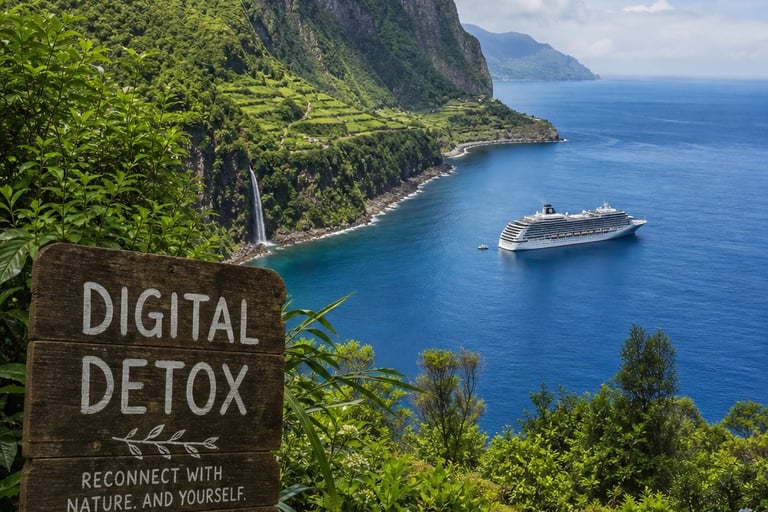
Unobstructed Horizons: Use cantilevered platforms or glass enclosures (like a Solarium) to provide the "visual expansion" the brain craves to calm threat-detection systems.
Circadian Lighting: Utilize natural light integration to regulate the suprachiasmatic nucleus, which is frequently disrupted by artificial office lighting.
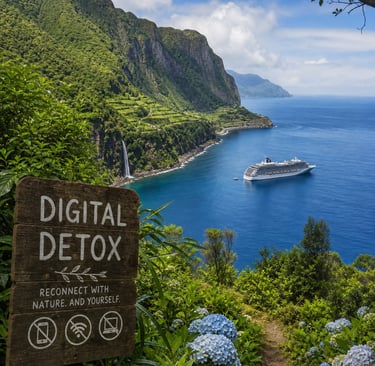
The transition from physical design to cultural shift is solidified through the implementation of a "Digital Detox."
Engineering the 'Unplugged' Culture: Digital Detox and Circadian Reset
Strategic wellness requires the removal of "productivity guilt." True recovery is not achieved through willpower but through structural detox—creating environments where disconnection is the default setting.
Structural vs. Willpower-Based Detox
In the urban environment, willpower is constantly depleted by the accessibility of technology. On the ocean, the structural barriers (such as high WiFi costs and spotty signals) provide the psychological "permission" to disconnect. Employees quickly realize that "the world continues spinning fine" without constant monitoring. HR should implement "No-Phone Zones" and "Airplane Mode" windows during retreats to mirror this liberating effect.
The Sunset Ritual: A Neurological Expansion
The "Sunset Ritual" is a powerful tool for regulating circadian rhythms. The gradual nature of an ocean sunset provides specific visual information that signals the brain's clock (the suprachiasmatic nucleus) to transition the body into a restorative state.
Corporate Takeaway
Activity
End-of-day sessions to signal the transition out of work.
Primary Benefit
Tactile self-care that triggers "Embodied Blue Mind" awareness.
Reduces systemic inflammation and encourages presence.
Provide "Green/Blue" barefoot zones in office gardens
Sea-Salt Scrub Ritual
Barefoot Grounding
Combines low-impact movement with circadian regulation
Distribute salt-based grooming kits in office wellness suites.
Low-stakes creative workshops to break cognitive loops.
Sunset Yoga
Mindful Shell Collecting
fosters child-like wonder and sensory focus.
Healing Shore-side Activity Guide
The HR Implementation Roadmap: Dose, Proximity, and Quality
To maximize the return on human capital, HR must operationalize the Dose-Response Relationship and move toward an "upstream health promotion intervention" model.
The Minimum Effective Dose & Proximity
The 20-30 Minute Threshold: The daily duration required to trigger measurable drops in cortisol and heart rate variability.
The 120-Minute Weekly Target: The cumulative threshold for significant long-term mental health improvements.
The 1km Proximity Rule: Employees living or working within 1 kilometer of blue space show significantly better mental health outcomes; prioritize site selection within this radius for offices and retreats.
Blue Space Quality Framework Checklist
When evaluating environments for employee use, HR must assess:
[ ] Water Quality: Clarity and safety (Murky water can trigger aversion/anxiety).
[ ] Sensory Soundscape: Prevalence of natural water sounds vs. industrial noise.
[ ] Activity Affordances: Support for both passive observation and active immersion.
[ ] Visual Openness: Unobstructed sightlines and horizons for neural downshifting.
[ ] Social Anchors: The capacity for the space to facilitate group interaction and social connectedness.
Specialized "Blue Care"
For teams facing extreme burnout or high-risk trauma (e.g., executives or first responders), consider structured "Blue Care":
Surf Therapy: Integrating physical ocean immersion with group processing.
Thalassotherapy: Utilizing seawater-based treatments for clinical rehabilitation.
By adopting a "Bluescription" culture, an organization transforms the ocean/water value equation from an elective luxury to a fundamental pillar of health. This regenerative feedback loop ensures that as we take care of our waters, they—in turn—take care of our people.
Connect
Feel free to reach out anytime
The Aquatic Therapy Hub© 2026. All rights reserved.
Navigation